
A Closer Look at the 2026 Workforce
7 min read
Strategic Insights from the LinkedIn Labor Market Report
As we enter a new year, understanding the dynamics shaping the future of work is critical. LinkedIn’s January 2026 Labor Market Report, compiled from over 1.3 billion members, reveals a complex picture: global hiring remains 20% below pre-pandemic levels, and job transitions have hit a ten-year low. Yet these data points tell more than just a story of slowdown, they chart the roadmap of transformation.
Contrary to headlines, the slowdown in hiring is not a consequence of artificial intelligence. LinkedIn data shows that economic uncertainty and monetary policy shifts are the primary drivers. While advanced economies face the greatest challenges (with hiring down 20-35% compared to pre-pandemic levels) emerging markets are demonstrating strong momentum.
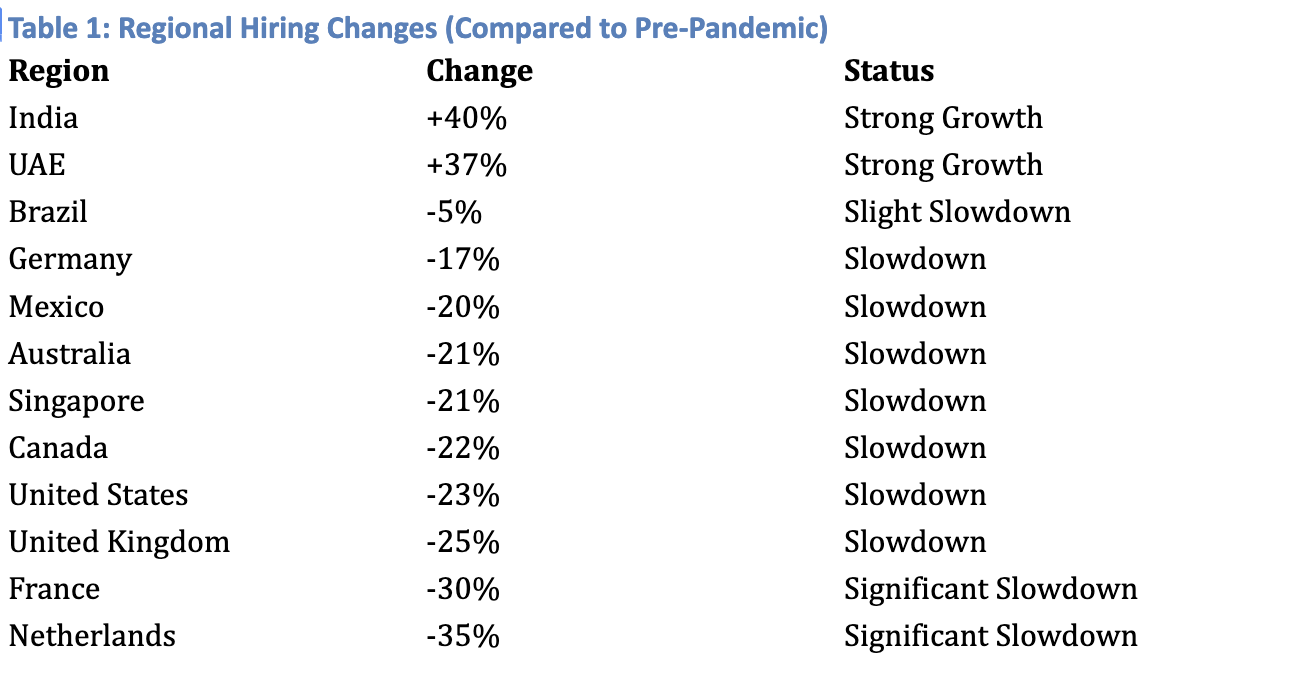
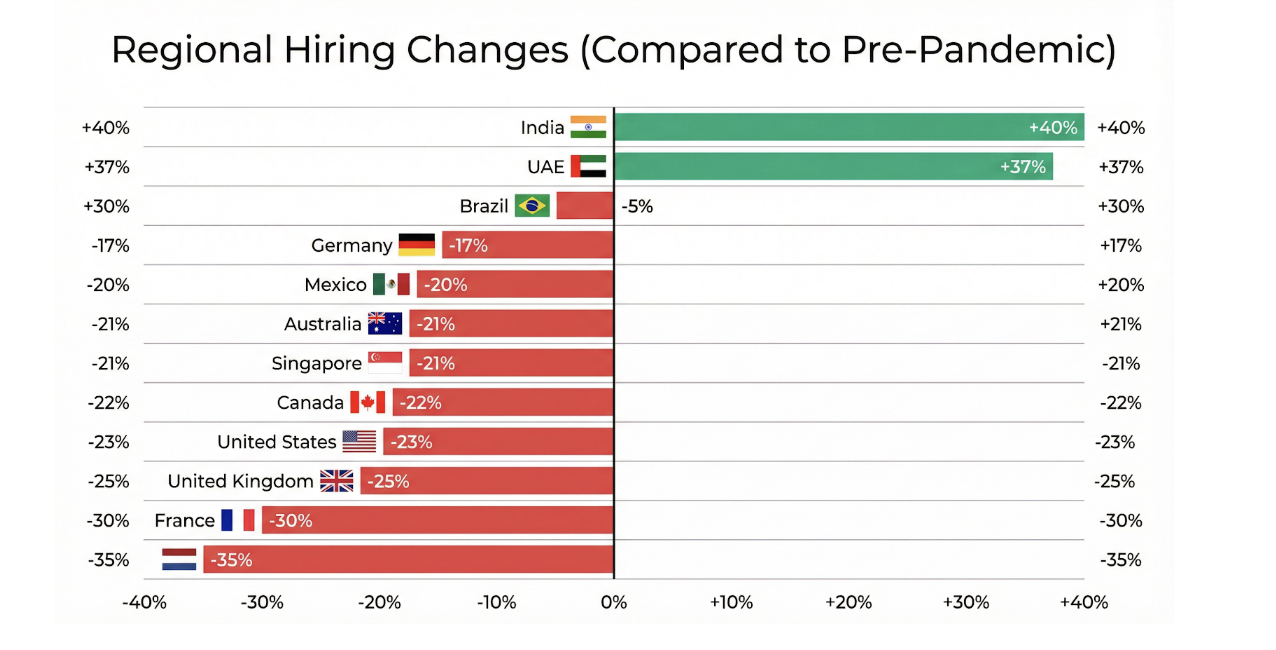
Regional Hiring Changes
This table demonstrates that the labor market is not retreating globally but rotating. While markets like India and the UAE are becoming centers of new opportunity, traditional economies like the US and UK are undergoing structural transformation. The LinkedIn report emphasizes that labor market momentum is largely confined to a few markets: India, the Middle East, Healthcare, Education, and Consumer Services sectors are leading the way.
This rotation in the global labor market reveals that companies need to use geographic flexibility as a strategic growth lever. Deliberate decisions about where work is done can align cost and skill balance in favor of both efficiency and growth.
According to the report, AI is creating more jobs in the near term than it is displacing. Over the past two years (2023-2025), at least 1.3 million AI-related job opportunities have emerged globally. Roles that didn’t exist five years ago, such as data annotators, AI engineers and forward-deployed engineers, have become indispensable components of digital economies.
New Jobs Created by AI
Particularly striking is the 42-fold growth in forward-deployed engineer roles and the 13-fold growth in AI engineer roles since 2023. These are change management positions that ensure AI is effectively integrated into business processes. Data annotators perform essential functions that keep AI systems aligned with human judgment and accountable.
Notably, entry-level roles are not disproportionately affected by AI. LinkedIn data shows that entry-level hiring is tracking in parallel with experienced positions, confirming that the current slowdown is macroeconomic, not technological, in origin. While jobs requiring AI literacy in the US grew 70% year-over-year, this growth is distributed evenly across all experience levels.
The report emphasizes that “new collar” roles form the backbone of the new economy. These roles require hybrid skills: technical fluency, manual capability, and continuous adaptability. The traditional blue-collar and white-collar distinction is becoming meaningless in this new era. What matters is not diplomas or titles, but the skills possessed and the ability to adapt them to changing conditions.
According to US Bureau of Labor Statistics projections, approximately 60% of new jobs by 2030 will come from occupations that typically don’t require a college degree. These roles will offer good pay and undergo the new-collar transformation reshaping the labor market. Workers of all ages and backgrounds are showing rising interest in charting their own paths as entrepreneurs, creators, and tradespeople, and have more opportunities to shape their own careers in a fast-changing labor market.
AI Literacy: The ability to understand and use technology is becoming a fundamental competency across all sectors.
Conflict Management: Reconciling different viewpoints and producing solutions is an indispensable part of working in diverse teams.
Adaptability: The ability to quickly adapt to changing conditions is the most valuable talent in times of uncertainty.
Process Optimization: Developing methods to increase efficiency delivers powerful results when combined with AI tools.
Innovative Thinking: The ability to generate new ideas outside the box plays a critical role in solving complex problems.
This skill mix reflects a reality supported by comprehensive recent research: Organizations implementing diversity and inclusion initiatives are achieving multiple benefits, including increased innovation, improved decision-making processes, and higher employee engagement. A meta-analysis published in 2024 reveals that diverse teams focus more on facts and develop stronger decision-making processes. The combination of AI skills and human capabilities creates the formula that will give companies a competitive advantage. Just as a forest is more resilient than a monoculture plantation, teams with different perspectives and skills produce more successful solutions than homogeneous groups.
One of the most effective and cost-efficient ways to adapt to the changing business world is upskilling current employees. Companies can grow their AI talent pipelines 8.2 times faster globally by focusing on skills rather than titles or degrees.
Internal mobility is an effective strategy in both time and cost terms. When employees find new roles and opportunities within their own organizations, both their engagement increases and the company can respond quickly to changing business needs.
As application volumes increase, professional networks are becoming an increasingly valuable signal. Globally, job seekers now outnumber job openings more than at any time since the pandemic. In this highly competitive environment, having the right connections makes a critical difference.
According to the report, applicants who are already connected to an employee at the target company are 3.6 times more likely to be hired. This is critical data from both candidate and employer perspectives: Ignoring the network effect in hiring processes leads to both time loss and missed quality candidates.
For leaders, this finding emphasizes the strategic importance of strengthening employee networks. Leaders who regularly post on LinkedIn drive visibility to their businesses and increase employee engagement. Employees can attract quality candidates to their companies using their own networks and accelerate the hiring process.
LinkedIn’s recommendations require a proactive approach:
Build Resilience Through AI + Human Skills: Upskill your workforce across both AI literacy and people skills such as design thinking and adaptability.
Consider AI Change Management Roles: In addition to driving AI adoption, consider hiring for roles focused on effective AI integration such as forward-deployed engineers/managers and data annotators.
Look for Hidden Talent Internally: By focusing on skills over degrees or job titles, companies can grow their AI talent pipeline 8.2 times globally. Internal mobility is both a time- and cost-effective strategy to adapt to changing business needs.
Build Strong Employee Networks and Increase Engagement: As application volumes increase, connections become increasingly valuable signals. Applicants are 3.6 times more likely to get hired if they’re connected to an employee at that company on LinkedIn.
Use Geographic Flexibility as a Growth Lever: Being deliberate about where work is done can align costs and skills in ways that support both efficiency and growth.
Just as diversity transforms a plantation into a forest, today’s business world requires bringing together different perspectives, skills, and approaches. AI is not the enemy of this transformation but its catalyst. The real question is not “Will AI change us?” but “Will we direct this change, or will we allow ourselves to be swept along?”
As we explored in our latest blog, “the stranger at the table” is not a threat to belonging, but a reminder of why belonging still matters. Because some doors can only be opened from the outside. Research shows that organizations with inclusive climates achieve higher employee engagement, lower turnover rates, and improved performance outcomes. In an AI-shaped future, competitive advantage may lie less in technology alone and more in how human diversity and AI capability come together.
References
LinkedIn Economic Graph Research Institute. (2026). Labor Market Report: Building a Future of Work That Works. January 2026.
Okatta, C. G., Ajayi, F. A., & Olawale, O. (2024). Enhancing organizational performance through diversity and inclusion initiatives: A meta-analysis. International Journal of Applied Research in Social Sciences, 6(4), 734–758. https://doi.org/10.51594/ijarss.v6i4.1065