How Work is Transforming from Ranks to Skills
4 min read
Introduction: At the Threshold of a New Era
The world of work has not stood at the precipice of such a profound transformation since the Industrial Revolution. Artificial Intelligence (AI), particularly generative AI models, is no longer a distant future scenario but a tangible force actively reshaping workflows, job definitions, and career trajectories. At Talentra, we are taking the pulse of this silent revolution and analyzing the changes, risks, and opportunities that the next twenty years will bring. The forecasts we have compiled from comprehensive reports [1, 2] offer a clear vision of what awaits us on the horizons of 2035 and 2045. This transformation is not an extinction event, but rather a restructuring process in which talents and roles are redefined, and human-machine collaboration becomes the new norm.
The Great Shift: The Automation and Augmentation Dilemma
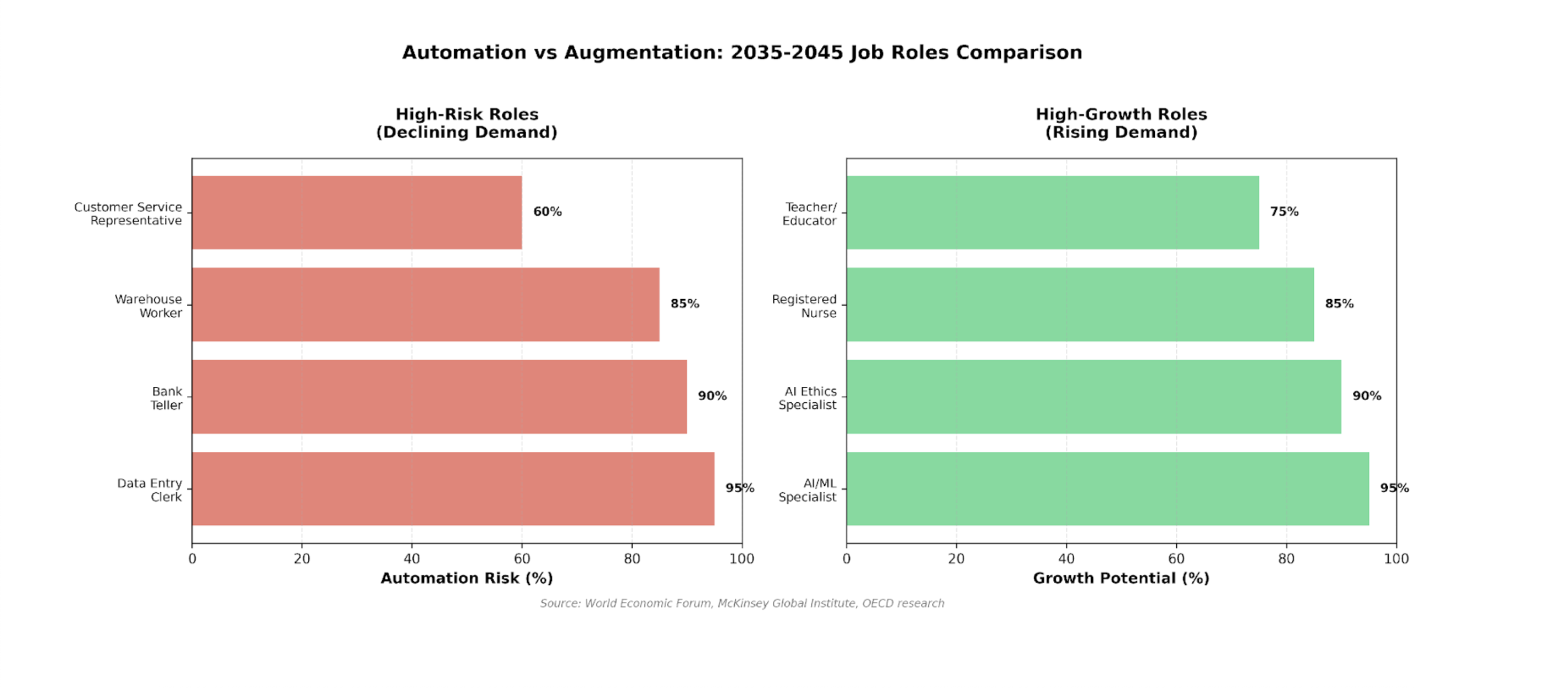
The impact of artificial intelligence on the workforce is not one-dimensional. On one hand, it emerges as a force that automates routine and repetitive tasks, while on the other, it assumes an "augmentation" role that enhances human capabilities and enables us to focus on more complex and creative work. The World Economic Forum (WEF) projects that by 2030, 92 million job positions will be displaced but replaced by new ones, resulting in a net creation of 78 million new job opportunities [1]. However, this transition will not be painless. Particularly in developed economies, up to 60% of current jobs will be exposed to AI impact, and 40% of workers will need to undergo significant reskilling in the coming years [2].
This dilemma demonstrates that while some professions face automation risk, others will become even more valuable thanks to AI. The chart below clearly illustrates this distinction.
The 2045 Vision: Emerging Professions and Sectoral Evolution
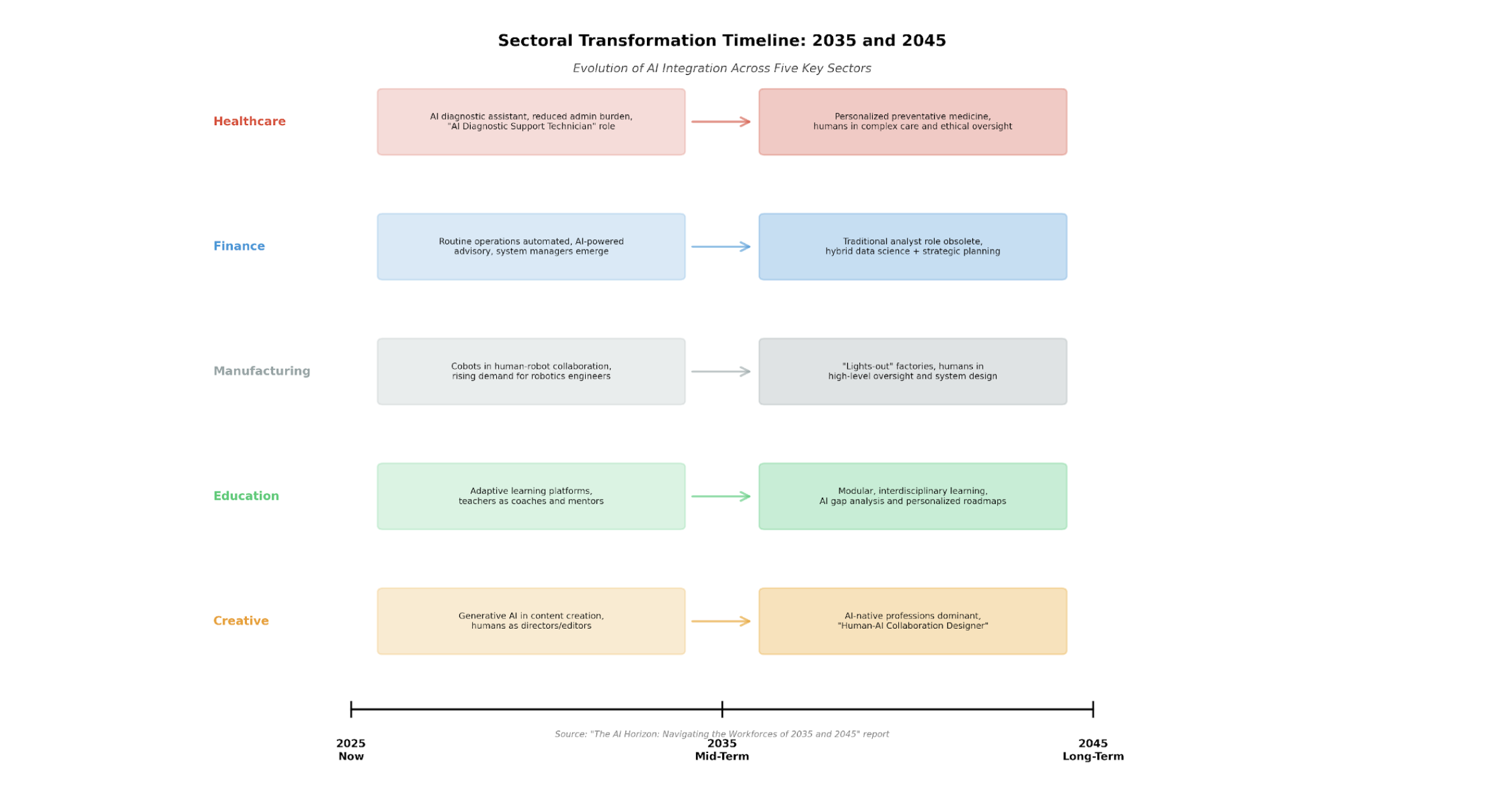
In the long term, by the time we reach 2045, the business world will differ radically from today. Many traditional professions will either disappear entirely or transform into hybrid roles based on human-AI collaboration. "Lights-out" factories, managed entirely by autonomous systems, will become the norm, while human expertise will shift to areas such as high-level oversight, strategic planning, and ethical supervision.
During this period, entirely new professions that did not previously exist will emerge. For example, roles such as "AI Ethics Specialist," "AI Security and Governance Specialist," "Human-AI Collaboration Designer," and "Adaptive Curriculum System Designer" will become critical positions managing the interaction between technology and humans.
The timeline below summarizes the projected transformation that five key sectors will undergo in 2035 and 2045.
Competencies of the Future: The 2045 Skills Matrix
In this new age where technology takes over routine tasks, the competencies that make humans indispensable come to the forefront. While rote knowledge and repeatable skills lose their value, abilities such as complex problem-solving, critical thinking, creativity, and emotional intelligence will create what is called the "human premium." The 2045 Skills Matrix, developed based on analyses from institutions such as the World Economic Forum, Coursera, and LinkedIn, defines four main competency categories that future professionals must possess.
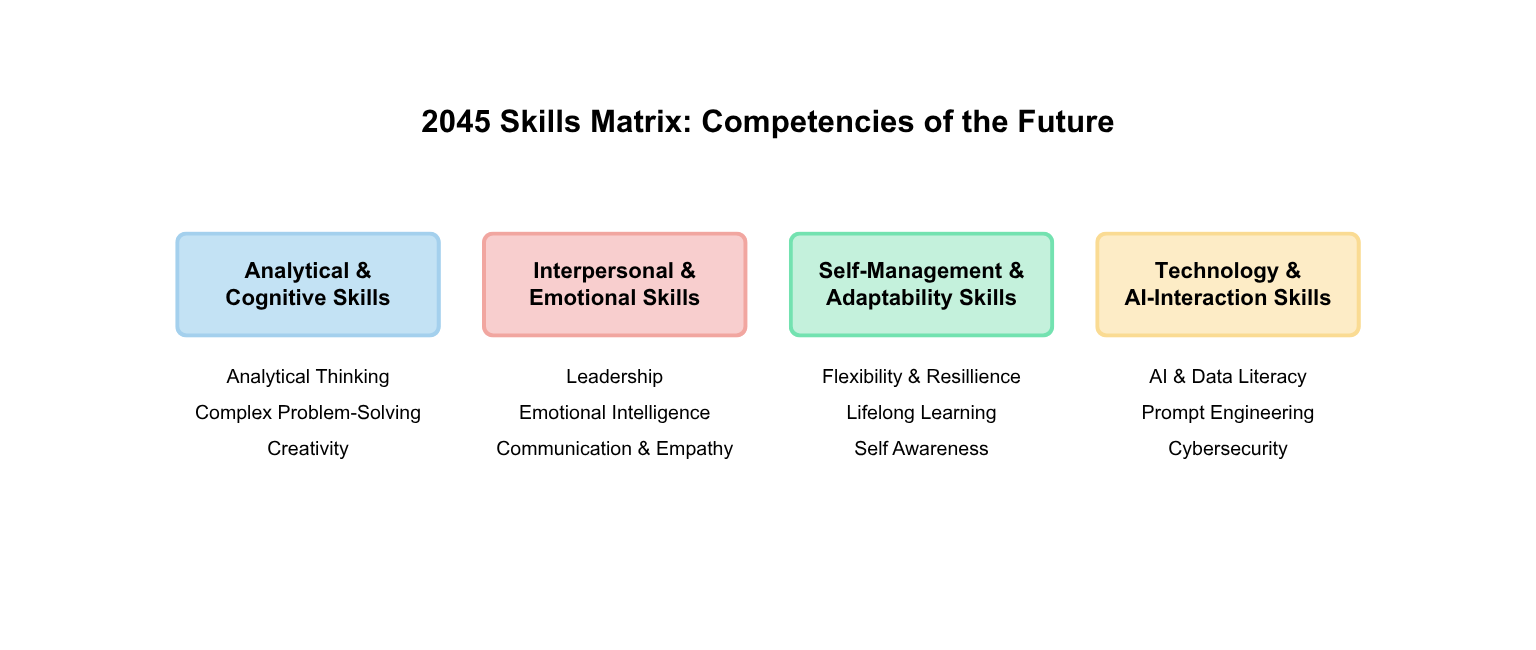
This matrix guides individuals in their career development while also indicating that companies must build their recruitment and training strategies upon these fundamental skills. Particularly, skills such as AI and Data Literacy and Communication and Empathy are among the fastest-growing competencies [2].
Conclusion: Shaping the Future Is in Our Hands
The artificial intelligence revolution is not an end to be feared but a beginning to be managed with the right strategies. For both individuals and organizations, a proactive adaptation and continuous learning mindset is the key to emerging successfully from this transformation. Companies must move away from rigid hierarchical structures and traditional job definitions, embracing a culture that is skill-focused, flexible, and encourages human-AI collaboration.
At Talentra, we closely monitor the challenges and opportunities brought by this new era, helping our business partners prepare their talent strategies for the future. With our role evolving from "talent hunting" to "talent orchestration," we ensure that companies become winners not only of today but also of tomorrow.
References
World Economic Forum. (2025). The future of jobs report 2025.
Global AI jobs barometer. (2025).
MIT Shaping the Future of Work. (2024).